AI is the Hype right know and this one day conference was dedicated to dig deep into the area from the software testing perspective.
21st of November 2023, https://sast-autumn2023.confetti.events
Generative AI
The day started with a recap (introduction for newbies) within AI guided by Marcus Landström from Forefront.
Artificial Intelligence (AI) is a computer/machine designed to have human intelligence. We are not there yet, because our ”narrow” AI of today can only handle particular functions.
Artificial General Intelligence (AGI) however, possesses the ability to understand, learn, and apply intelligence to solve any problem – like the human brain.
Artificial Super Intelligence (ASI) surpasses human intelligence in all aspects—creativity, wisdom, problem-solving, and social skills.
Other key words within AI are Machine Learning (ML) the key enabler when it comes to train the AI, Large Language Model (LLM) and Generative Pre-trained Transformers (GPT) which are simply larger families of LLMs. Google was the first out with LLM and OpenAI was the ones first launching (Chat)GPT.
We also learned that AI has been around for many years, dating back to the second part of the last century when the first attempts to make machines perform tasks that would typically require human intelligence were constructed.
Now, if you ask Google and ChatGPT the question “When was AI introduced for the first time”, you get slightly different answers….this because they use different techniques and models; Google choses a suitable language model and transformers, while ChatGPT uses one large Generative Pre-Trained Transformer.
One thing to remember, is that asking a question the old-fashioned way using e.g. Google or Bing instead of e.g. ChatGPT, has a much smaller environmental impact. The deep-learning of a Generative Pre-Trained Transformer consumes 50 times more computational resources than simpler Large Language Models.
Several actors and initiatives exists; Microsoft is launching Copilot, Bing it’s BingChat, Facebook’s initiative is Meta, Google goes for PALM2 and there is also a Swedish initiative called SWE GPT
Unclock the test potential using AI-driven (test) tools
Maryia Tuleika, tester at Regent AB, talked about the immaturity of AI when it comes to the subject testing;
- Test-as-a-Service is very costly to implement because domain knowledge is (nowadays) a soft communication i.e. the lack of computable knowledge (requirements, design specifications) of the domain prohibits us tester to use AI to create domain level automated tests.
- our test tools are often designed to only master one type of testing e.g. API-testing, GUI-testing, DB-testing.
Examples: the API test tool Postman that can autogenerate tests of RESDTful web services and the major IDEs, such as IntelliJ and MS Visual Studio, that can autogenerate unit tests
There are some trials going on, driven by e.g. Blekinge Högskola, to develop tools for AI driven cognitive testing but the issue of lack of data to teach the models is an impediment. Katalon Studio and MS Cognitive Services are examples of such initiatives.
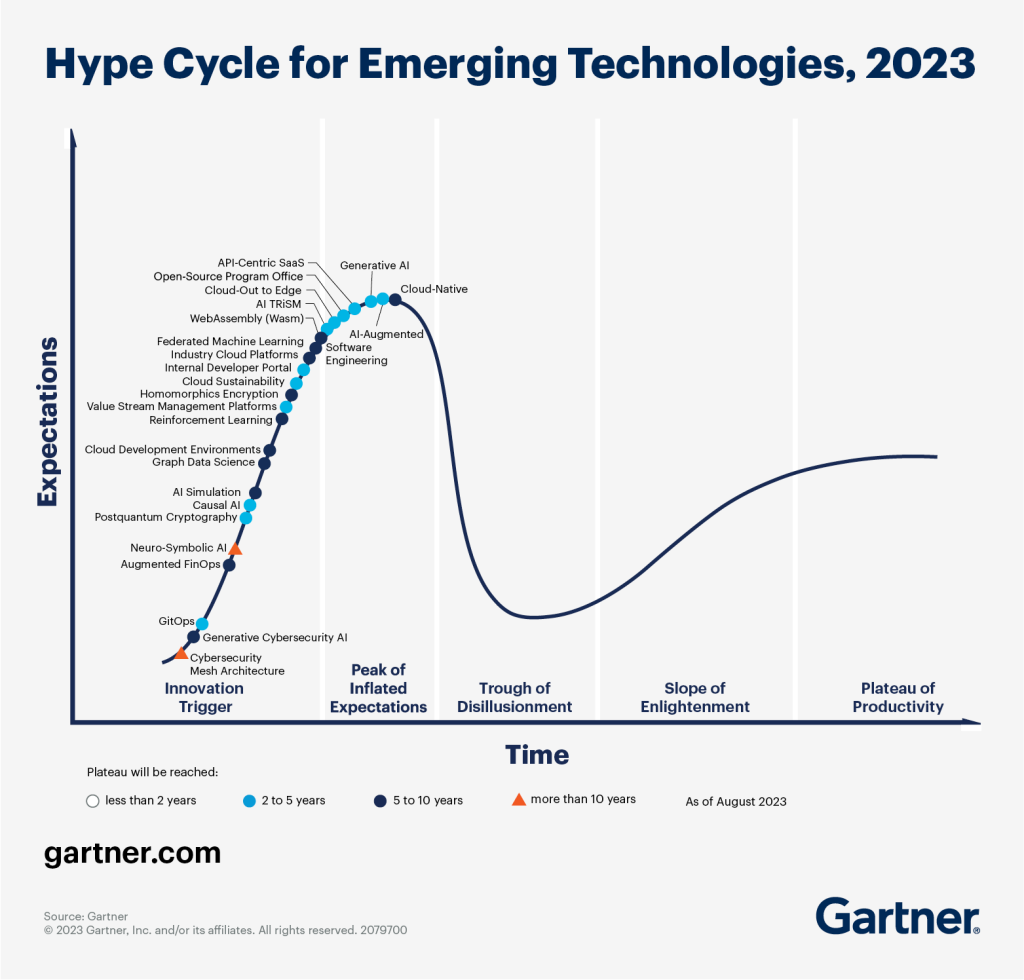
When looking at Gartner’s “Hype cycle“, it becomes obvious that generative AI is still a hype 🙂
Towards AI-driven Test Recommender Systems
Karl Meinke, Professor at KTH, joined the conclusion that the AI-journey within testing is in very early stages.
He dived into the field of machine learning;
- Active ML lets the model ask for the most useful data
- Passive ML just learns from what it’s given
- Adversarial ML involves techniques where models are trained or tested against deliberately modified inputs (called adversarial examples) designed to fool them
Machine Learning gives us better opportunities to implement Metamorphic Testing (https://en.wikipedia.org/wiki/Metamorphic_testing) and generate synthetic data.
Fighting on the barricades of humanism in an artificial context
Kristina Sabotic from Zington gave us all a weak-up call regarding the subject Burn out. She open-hearted told us about her journey. The introduction of the talk on SAST homepage says it all, so I’ll just quote it (translated into Swedish):
As test leaders, we’ve been trained to detect errors — not just in software, but everywhere! Being a test leader in a project often means we also spot what’s dysfunctional in the way we work. Sometimes proactively, thanks to our habit of thinking in terms of risk, or later, when chaos breaks out.
We also tend to take on these responsibilities in addition to our regular testing activities. In the short term, this benefits the projects we work on, but it also carries a personal risk of unhealthy stress and burnout.
So let’s talk about stress management and exhaustion! Gain insight into how burnout works and what the journey back can look like.
My insights and reflections of ”AI in Testing,,
Well, after listening to all the talks, I made the conclusion that AI is not really that mature yet to give assistance within system test automation.
The support in test tools is not high. Yes, machine learning is there; like e.g. generating tests given a REST-schema, code completion in IDEs and static code analysis tools. But when it comes to cognitive testing, the available tools have just started to arise and offers very basic capabilities at the moment.
The trickiness when it comes to AI-supported system testing lies within the modeling capabilities and that there is often too little computable data available for the model to learn from. This causes the deep-learnings to produce skew models.
The reason for this is that the domain knowledge needed to train the models is still in the human brains (soft communication) i.e. the superusers of each software product. Very few company nowadays write down their architecture and the requirements, thus there is no data for the models to train on.
So we system level testers need not to worry – AI cannot supersede us in test case design, nor quality assurance, so we are still attractive (for companies focusing on quality).
Although AI performs poorly in the field of cognitive testing, it is a very good support we can still gain a lot from the machine leraning evolution that comes with in the field of creating a test base, especially when it comes to testdata.
But maybe it is not about what AI can or cannot do – the AI-assisted workday should give us room to enjoy people-to-people communication. Why do I have the feeling we are going in the other direction, that all the ”AI-assistants” makes us work more on our own instead of pair programming/testing? AI will not solve bad cultures and impossible working conditions in workplaces, that the humans have to sort out themselves.
With the AI Hype swirling around, it becomes even more important to remember the Agile Manifesto’s ”Individuals and interactions over processes and tools,,